A standard is written by a regulator. Your quality system also writes rules for itself, and no external standard can tell you where two of your own procedures disagree.
- ·01Your rules, read out of your documents
- Every rule your documents set themselves: an approval table every document must carry, a numbering convention, the forms a procedure requires. Each rule keeps the passage it was read from.
- ·02Checked against the whole library
- Each rule is checked against every document it governs, and its verdict follows from what each document shows: covered, partial or gap. A document is credited only with a passage found in it.
- ·03Conflicts first
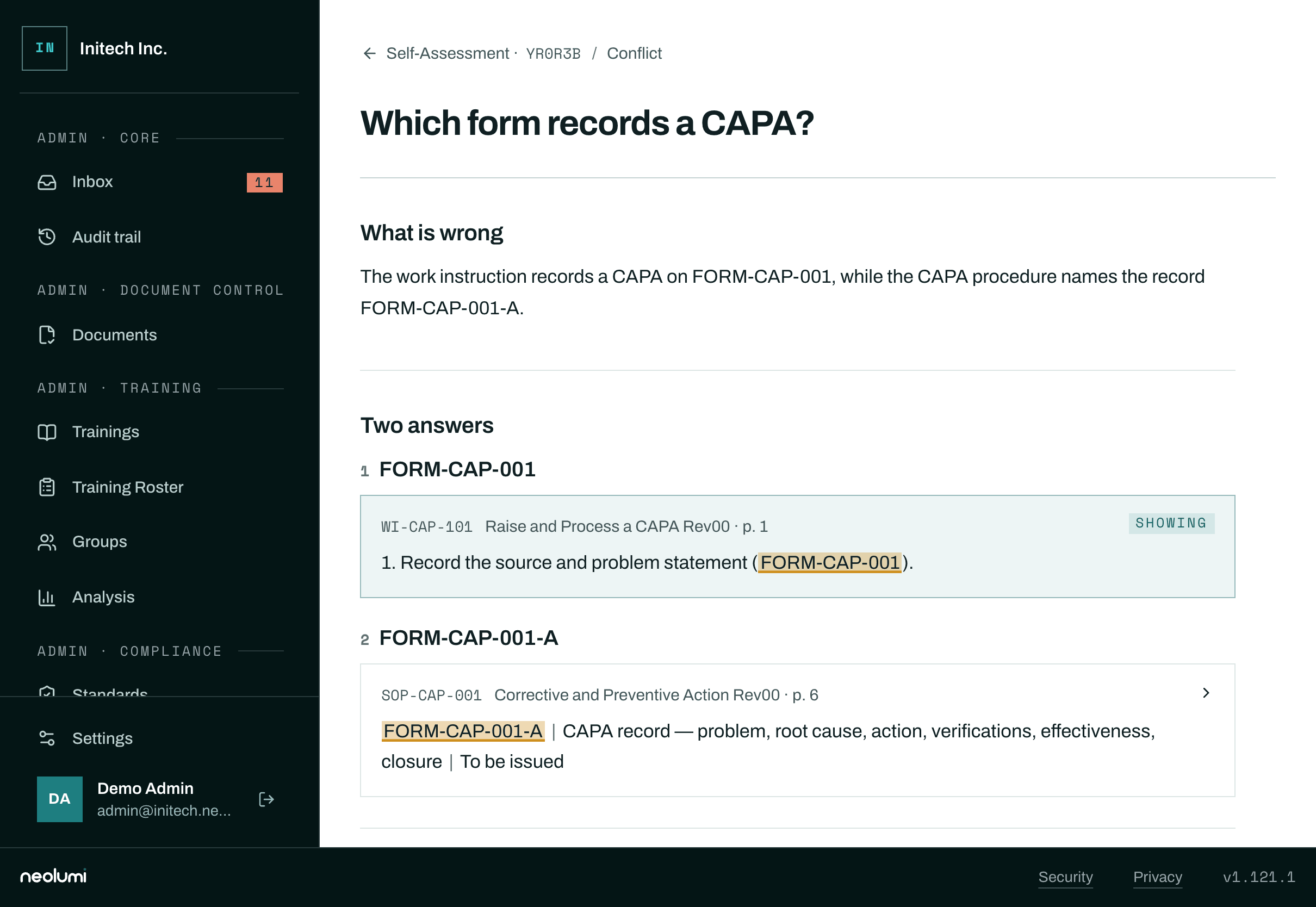
- Where your own documents answer one question differently, the conflict leads the page: the question, each answer, the documents giving it, and the words in contention marked on the page.
- ·04Discussed, then read again
- Every finding can be discussed. Run it again and only what moved is read again: the document that changed, the rule that was questioned.
READ AGAINSTYOUR OWN RULES
FINDINGCONFLICT
DOCUMENTS3
- QUESTIONOPEN
- Who approves an editorial revision? Three of your documents set the rule, and they do not agree.
- ANSWER A2 DOCUMENTS
- Quality assurance, always. Every revision is approved by quality assurance, editorial or not.CITED · SOP-DOC-001 · P.4 · QM-001 · P.11
- ANSWER B1 DOCUMENT
- The owner, alone. The document's owner may approve an editorial revision without quality assurance.CITED · SOP-QA-003 · P.2